



One molecule, four structures: researchers reveal how supramolecular structures determine which structure to adopt
31.08.2026
 |
|
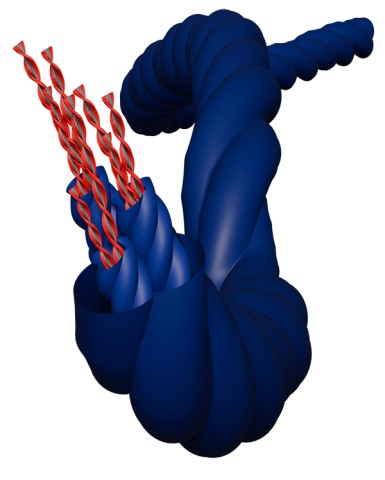
Superhelix structure. Image: Kyeong-Im Hong. |
- Research carried out by the ICMM-CSIC and IMDEA Nanociencia institutes has uncovered the steps involved in the assembly of complex molecules.
- This discovery has implications ranging from semiconductors to the pharmaceutical industry.
| Tweet |  |
Press release download |
Madrid, 31st August, 2026. The properties of matter do not depend solely on the atoms of which it is composed, but also on the way in which these atoms are organised. At the nanometre scale, small differences in the spatial arrangement of atoms can give rise to structures with completely different properties. Understanding why some molecules adopt a particular organisation and others a different one is essential for designing materials with specific properties.
A group of researchers, led by Prof. Thomas Hermans (IMDEA Nanociencia) and Amparo Ruiz Carretero (ICMM-CSIC), have succeeded in controlling the steps by which helical supramolecular structures form (assemble) and in isolating them. As a result, they have been able to manipulate these structures ‘à la carte’, creating up to four independent systems from a single molecule.
“A single molecule, depending on how it is processed, can form different types of supramolecular structures,” explains Amparo Ruiz Carretero, an ATRAE researcher at the Institute of Materials Science in Madrid (ICMM-CSIC) and lead author of the study. She points out that this is true of any type of molecule, but that the complexity is greater when the molecule is chiral: those with helix-like structures. “They are mirror images that cannot be superimposed because they have no plane of symmetry; this is what happens with DNA,” she continues.
In this context, “understanding how molecular chirality propagates to generate hierarchical structures remains a central challenge in supramolecular chemistry”, adds Thomas M. Hermans, an ATRAE researcher at IMDEA Nanociencia and also a lead author of the study.
“The most important thing about this type of structure is that they cannot normally be isolated,” says Ruiz Carretero. “They are ephemeral; you detect them through spectroscopy – the study of the interaction between light and matter – and the spectrum tells you they are there, but you cannot see them, let alone manipulate or use them.”
Study using calorimetry and structural manipulation
Thanks to a complex experimental technique based on heat – known as Isothermal Titration Calorimetry (ITC) – which had hardly ever been used before, they have managed to determine the formation energy of each structure, marking a significant experimental milestone. “Normally, the assembly energy is calculated using simplified mathematical models based on various assumptions. Now, we know the exact values,” explains Ruiz Carretero.
Furthermore, not only have they been able to isolate the molecular structures, but also to manipulate them at will. “We have discovered that they are interconvertible: you can take a small piece of one structure and transfer it to another, and this technique also helps us to see what kind of assembly mechanism is involved in the transition from one to the other,” explains Hermans.
Ruiz Carretero continues: “We have four supramolecular structures and we select the one that works best for our objective, but we also add ‘bits’ from another to incorporate effects that interest us.”
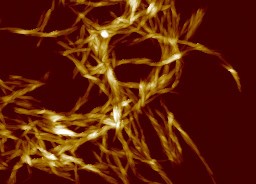 The team argues that their study can be applied in a wide range of fields. In fact, they also link it to amyloids in Alzheimer’s disease. Amyloids are proteins that misfold and form insoluble fibres that accumulate in tissues and organs: “some of these fibres form helices, whilst others form superhelices through a process called secondary nucleation”. The same occurs with the molecules they have worked with in this study.
Now, each research team will continue to make progress in complementary directions within chiral supramolecular chemistry: “We have developed different design strategies,” they explain. Thus, Amparo Ruiz Carretero will continue her ATRAE project, aimed at “shedding light on how chirality can drive advances in organic photovoltaics”, whilst Thomas M. Hermans will make progress in supramolecular robotics.
“In this study we have worked with semiconductors, but the results can be applied to spintronics, pharmaceuticals, photovoltaics, thermoelectricity…”, the researchers list. “Once you have isolated the structure, you can manipulate and study it in any medium”, they celebrate, whilst adding that they have already developed some of these samples.
“These results provide an exceptional, experimentally confirmed example of how simply choosing the pathway of structural formation can programme chirality, hierarchy and morphology in supramolecular materials,” the team concludes.
The work is a collaboration between researchers at ICMM-CSIC, IMDEA Nanociencia, the University of Strasbourg (CNRS) and the Autonomous University of Madrid. It has been co-funded by the Ministry of Science, Innovation and Universities through the ATRAE programme, and by the Severo Ochoa Accreditation of Excellence.
Glossary:
- Chirality: the property of a molecule that allows it to exist in two forms that are mirror images of each other and cannot be superimposed..
- Supramolecular structure: a complex structure formed when several molecules organize and are held together through non-covalent interactions (chemical bonds).
Reference:
Kyeong-Im Hong, Jorge S. Valera, Ana M. Garcia, Thomas M. Hermans* and Amparo Ruiz-Carretero*. From Helices to Superhelices: Hierarchical Assembly across Competing Pathways. Nature Communications. DOI: 10.1038/s41467-026-76656-4
 Link to IMDEA Nanociencia Repository: https://hdl.handle.net/20.500.12614/4285
Contact:
Dr. Thomas M. Hermans
This email address is being protected from spambots. You need JavaScript enabled to view it.
Systems Chemistry Laboratory
https://www.imdeananociencia.org/systems-chemistry-laboratory/home
Oficina de Divulgación y Comunicación en IMDEA Nanociencia
divulgacion.nanociencia [at]imdea.org


Source: IMDEA Nanociencia.
IMDEA Nanociencia Institute is a young interdisciplinary research Centre in Madrid (Spain) dedicated to the exploration of nanoscience and the development of applications of nanotechnology in connection with innovative industries.