



Can a single molecule offer a new window into atomic-scale magnetism?
08.01.2026
 |
|
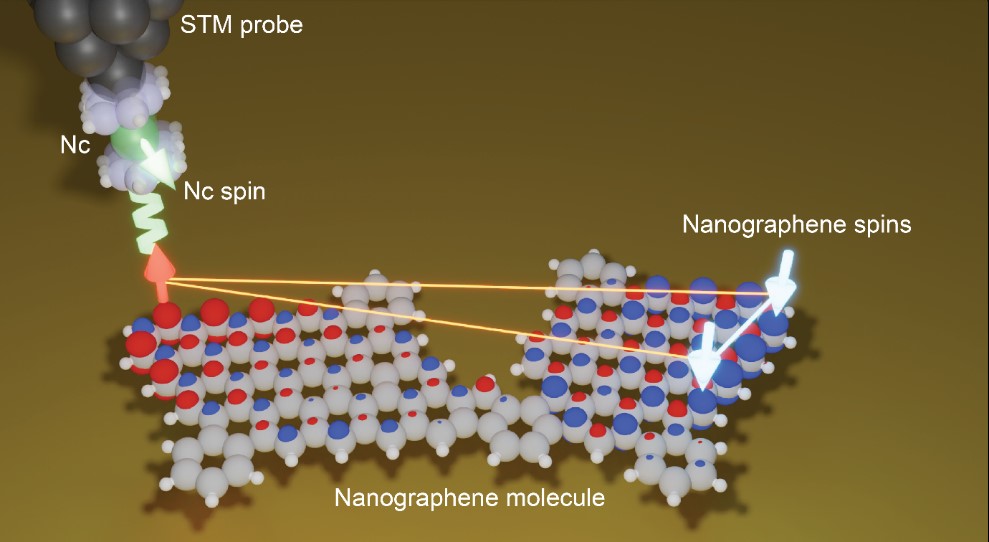
The interaction between the spin of a nickelocene (Nc) molecule at the apex of an STM probe with the spins of a magnetic nanographene molecule allow the molecule’s magnetic ground state to be determined. Credit: Ben Lowe. |
- IMDEA Nanociencia researchers develop a new kind of scanning tunnelling microscopy able to distinguish subtle differences in magnetic states.
- In collaboration with the Czech Academy of Sciences, researchers functionalise the STM tip with a nickelocene molecule, allowing the spin maps of nanographenes to be revealed.
| Tweet |  |
Press release download |
Madrid, 8th January, 2025. Researchers have recently demonstrated a powerful new way to distinguish subtle differences between magnetic ground states using an advanced form of scanning probe microscopy. In a study led by scientists at IMDEA Nanociencia and the Czech Academy of Sciences, the team employs scanning tunnelling microscopy (STM) to discriminate between distinct magnetic ground states in structurally similar nanographenes. The technique uses an STM tip functionalised with a nickelocene molecule, enabling the detection of characteristic signatures unique to each magnetic state and the imaging of spin distributions with atomic-scale precision. The work has been published by the Journal of the American Chemical Society.
Mixing things up: extracting magnetic information with nickelocene
Measurements using STM involve the “jumping” of electrons between an atomically sharp metal probe and a sample of interest at sub-nanometre distances. At this proximity, when the apex of the probe is decorated with a nickelocene molecule, the nickelocene spin can interact with the spins of a magnetic sample resulting in a mixing of their magnetic properties (via a process called exchange-coupling). The strength of this effect can be carefully controlled by precisely varying the probe-sample distance.
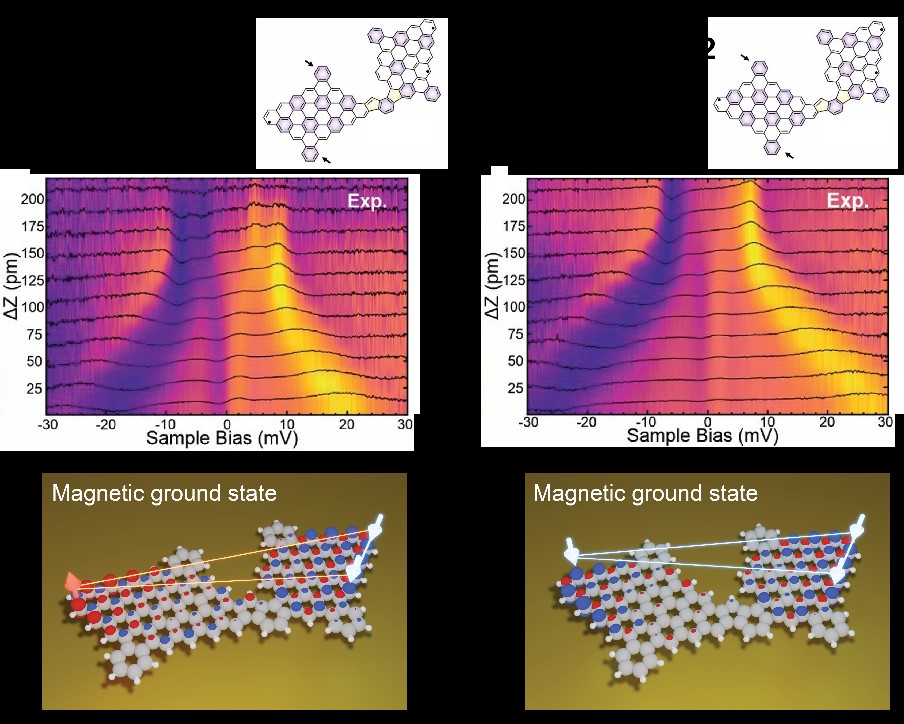 The magnetic properties of nickelocene itself are well understood. So, by comparing the mixed magnetic properties of nickelocene and a magnetic sample to models, the authors can extract information about the magnetic properties of the sample itself.
“One of my favourite things about this project is that the key to the problem was finding a simple spin model,” explains first author Diego Soler Polo, who recently finished his role as a postdoctoral researcher in the Nanosurf Lab group at the Institute of Physics (FZU) and begun a position at IMDEA Nanociencia. “And not just a heavy ab initio simulation... although of course we also did that.”
In this study, the authors compared two nanographene molecules with almost identical structures. Nickelocene spectroscopy measurements revealed subtly different signatures for each molecule. This allowed the researchers to conclude that, despite their structural similarity, the molecules have different magnetic ground states.
A slice of the pi
The nanographene molecules in this study are examples of a class of magnetic materials known as π (pi)-magnets. Some carbon-based materials feature delocalised electrons within so-called π-states – such as the two possible arrangements of alternating double and single bonds in a benzene ring. Unlike conventional magnetic materials, whose magnetism arises from unpaired electrons in metal centres, π-magnets have spins which live within these delocalised π-states.
“π-magnets are a recent class of materials whose high intrinsic reactivity severely challenges their stabilization using conventional solution-based synthetic approaches” explains José I. Urgel, group leader at IMDEA Nanociencia, “developments in synthetic protocols on-surfaces allowed for their synthesis for the first time – opening the door to this new field of magnetism.”
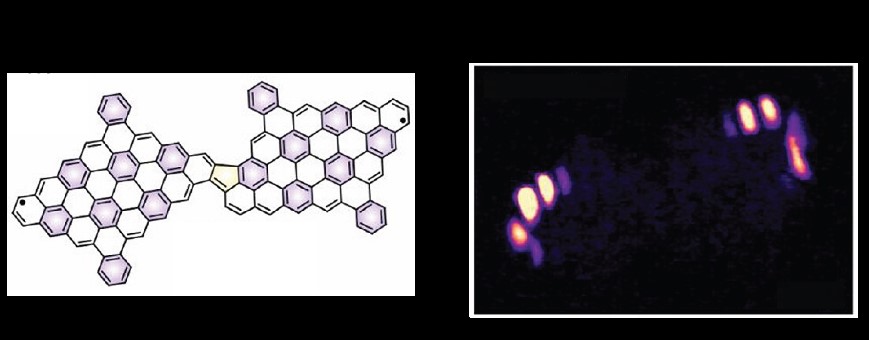
The nickelocene technique used by the authors is particularly useful for studying π-magnets. Along with determining the magnetic ground state, it can also be used to image the spatial distribution of delocalised magnetic properties at the atomic scale.
What’s next?
The demonstrated sensitivity to unique magnetic ground states and atomic-scale resolution makes the nickelocene a promising tool for characterizing correlated materials. As well as further characterisation of π-magnets, this technique might be able to shed new light on more exotic magnetic phases in 2D materials.
Urgel’s group at IMDEA Nanociencia, who are experts in π-magnetism, will continue to push towards new frontiers in these materials. As well as individual molecules, they will be working on π-magnetism in periodic structures which have the potential to be tuneable, flexible, and affordable platforms for realising quantum phenomena as the basis for new technologies.
The study was led by researchers at the Institute of Physics of the Czech Academy of Sciences (FZU) and the Madrid Institute for Advanced Studies in Nanoscience (IMDEA Nanociencia), with co-authors from the Okinawa Institute of Science and Technology Graduate University. The work was supported by the European Union, the Grant Agency of the Czech Republic, the Ministry of Education, Youth, and Sports of the Czech Republic, the Comunidad de Madrid, the Spanish Ministry of Science, Innovation, and Universities, and the Japan Society for Promotion of Science, the accreditation Excellence Severo Ochoa awarded to IMDEA Nanociencia (CEX2020-001039-S).
Glossary:
- Nanographene: a nanostructure or piece made from graphene —a sheet of hexagonal interlocked carbon atoms— with typically less than 100 nm size.
- Scanning tunnelling microscopy: is a type of microscopy that images surfaces at the atomic level, using the tunnelling effect. STM senses the surface using a sharp tip; when the tip is brought very near the surface, a voltage applied between the two allows electrons to tunnel through the vacuum separating them. The image is acquired by monitoring the current as the tip scans across the surface.
- Nickelocene: an organometallic compound with formula Ni(C5H5)2, in which the metal ion is sandwiched between two parallel cyclopentadienyl rings. It is a paramagnetic solid with interest in academic research, in this work, as a tip for STM studies.
Reference:
 Link to IMDEA Nanociencia Repository: https://hdl.handle.net/20.500.12614/4155
Contact:
José Ignacio Urgel
This email address is being protected from spambots. You need JavaScript enabled to view it.https://scanlab.es/Twitter/X: @nacho_urgel
IMDEA Nanociencia Dissemination and Communication Office
divulgacion.nanociencia [at]imdea.org


Source: IMDEA Nanociencia.
IMDEA Nanociencia Institute is a young interdisciplinary research Centre in Madrid (Spain) dedicated to the exploration of nanoscience and the development of applications of nanotechnology in connection with innovative industries.